On the other hand, this Seeing-Thinking Activity, produced and promoted by the NYT looks to be both an excellent resource and a lot of fun!
https://learning.blogs.nytimes.com/2015/02/27/10-intriguing-photographs-to-teach-close-reading-and-visual-thinking-skills/
Thursday, August 2, 2018

Thinking about critical thinking skills
Making predictions is good. It can even be a lot of fun. So why does the method of teaching children to think about what they are reading (DR-TA) feel so cumbersome and legalistic?
1. cf C.S. Lewis's looking along the beam vs. looking at the beam. This seems to take materials that are meant to be looked *along*, to be enjoyed, and to turn them into something to be looked *at*, at a possibly developmentally inappropriate stage.
2. It increases for the students the sense that there is right and wrong as regards prediction and interactions with texts. Conflating accurate / inaccurate with moral / immoral.
3. It becomes cumbersome and tedious to children who predict automatically and accurately, slowing down and interfering with the actual enjoyment of the book.
4. For children's books which may operate with an element of surprise (many), it functions to ruin the joke by explaining the joke. (Q: Tell me class, why did the author do this? A: To be silly. To make me laugh.)
5. The focusing on the "what" obscures the "how." Better questions: Did you like what happened? Would you have done the same thing?
Critical idea: give children "ownership" of their literature . . . let them be free to stand over it in judgement, not just under it, needing to "get it right."
So, perhaps I believe that this method of evaluating is not appropriate to materials that are to be consumed in one sitting, or by children who are too young to critically evaluate? Maybe we should encourage young kids to wonder and let the wondering be?
1. cf C.S. Lewis's looking along the beam vs. looking at the beam. This seems to take materials that are meant to be looked *along*, to be enjoyed, and to turn them into something to be looked *at*, at a possibly developmentally inappropriate stage.
2. It increases for the students the sense that there is right and wrong as regards prediction and interactions with texts. Conflating accurate / inaccurate with moral / immoral.
3. It becomes cumbersome and tedious to children who predict automatically and accurately, slowing down and interfering with the actual enjoyment of the book.
4. For children's books which may operate with an element of surprise (many), it functions to ruin the joke by explaining the joke. (Q: Tell me class, why did the author do this? A: To be silly. To make me laugh.)
5. The focusing on the "what" obscures the "how." Better questions: Did you like what happened? Would you have done the same thing?
Critical idea: give children "ownership" of their literature . . . let them be free to stand over it in judgement, not just under it, needing to "get it right."
So, perhaps I believe that this method of evaluating is not appropriate to materials that are to be consumed in one sitting, or by children who are too young to critically evaluate? Maybe we should encourage young kids to wonder and let the wondering be?
Saturday, January 6, 2018
King's Cake, 2018: Well, THAT was a success
Since I never follow the recipe, and don't always remember how I adjusted what, here are this year's notes on what I did with the recipe and how it worked:
I used regular butter and 1/4 c LF milk. I cut the sugar in the dough down from 3 TBSP to 1 TBSP. For the filling, I used 1/2 c dark brown sugar, 2 tsp cinnamon and 1/2 c chopped walnuts. The dough was quite crumbly, but patchable. The recipe calls for rolling it out into a 10" x 30" rectangle. I think it could have gone that far . . . but it would have been impossible to jelly roll at that point. I rolled it into a 12" x 18" rectangle and then jelly rolled it with a silicon baking mat. It didn't handle well at all when I tried to shape the log into a circle. It just broke. We just baked the broken pieces. I let it rise about 15 minutes and then baked it for 20.
For glaze: ~ 1 cup powdered sugar with 3 TBSP lemon juice and 3 TBSP water. Colored green and gold sugar, and some of the glaze with purple food coloring.
Flavor and texture with this "cake" was phenomenal. The dough was almost like pie crust in richness and flakiness. The balance of spice, sweetness and tang with the cinnamon, nutmeg and lemon in the glaze was great. No worries about this one not being pretty . . . it didn't last long enough to matter.
* * *
I used regular butter and 1/4 c LF milk. I cut the sugar in the dough down from 3 TBSP to 1 TBSP. For the filling, I used 1/2 c dark brown sugar, 2 tsp cinnamon and 1/2 c chopped walnuts. The dough was quite crumbly, but patchable. The recipe calls for rolling it out into a 10" x 30" rectangle. I think it could have gone that far . . . but it would have been impossible to jelly roll at that point. I rolled it into a 12" x 18" rectangle and then jelly rolled it with a silicon baking mat. It didn't handle well at all when I tried to shape the log into a circle. It just broke. We just baked the broken pieces. I let it rise about 15 minutes and then baked it for 20.
For glaze: ~ 1 cup powdered sugar with 3 TBSP lemon juice and 3 TBSP water. Colored green and gold sugar, and some of the glaze with purple food coloring.
Flavor and texture with this "cake" was phenomenal. The dough was almost like pie crust in richness and flakiness. The balance of spice, sweetness and tang with the cinnamon, nutmeg and lemon in the glaze was great. No worries about this one not being pretty . . . it didn't last long enough to matter.
* * *
Gluten
Free Kings Cake
INGREDIENTS:
§
¼ to ½ cup warm water
(110 F)
§ 1 Tbs.
granulated cane sugar
§ 1 TBSP
yeast
§ ½ cup unsalted butter or non-dairy alternative (coconut
oil)
- 1/8 to ¼ cup warm milk (dairy or non-dairy)
- 2 large eggs (room temperature)
- 3 cups GF flour
- ½ tsp. ground
nutmeg
- 2 tsp. baking powder
- ½ tsp. salt
- 2 Tbs. milk (dairy or non-dairy) for brushing on pastry
before baking (or egg wash?) (optional)
§ Filling
Ingredients:
- ¾ cup packed
light brown sugar
- 1 ½ tsp. ground
cinnamon
- ¼ cup flour (optional)
- 1 apple, peeled and chopped (optional)
- 2/3 cup chopped
pecans (optional)
METHOD:
Prepare
the filling by tossing the chopped apples together with the flour, brown
sugar and cinnamon. In a separate bowl, melt the 4 tablespoons butter, and set
both bowls aside.
In a
small bowl, combine the warm water, 1 tablespoon sugar and yeast; stir and set
aside to proof. If the mixture is not bubbly and doubled in volume after 5-10
minutes, toss out and start again with fresh yeast.
In a
large mixing bowl, blend the remaining 3 tablespoons sugar and butter until
light and fluffy. Add the milk and eggs and beat until well-integrated.
Add only 2 cups of flour, salt, baking powder and nutmeg and mix well. Stir in
the proofed yeast-sugar-water mixture, then add the remaining 1 cup flour. Beat
another 1-2 minutes, until the dough is clumping together and is not too
sticky.
Prepare
a large baking sheet by lining with parchment paper. Turn the dough out onto a
silicone pastry mat or onto a clean counter dusted lightly with flour (be sure
to have enough counter space, at least 30 inches wide).
Roll
the dough out to an elongated rectangle 24-30 inches long by 9-10 inches wide.
Brush on the melted butter, coating the entire rectangle.
Sprinkle
the filling mixture on top of the melted butter, spreading to the ends of the
rectangle, but leaving 1/2-1 inch without toppings on each of the long sides of
the rectangle.
Using a
bench scraper or a spatula, gently peel up one of the long sides of the
rectangle and begin rolling it as you would a jelly roll. Once the entire
pastry is rolled upon itself until no pastry remains unrolled, a 24-30 inch
long roll will remain. Gently pull the two ends of the roll together to form a
circle or oval.
Dabbing
the ends of the pastry with water, join the ends together to close the circle.
Gently transfer the ring to the parchment-lined baking sheet, or transfer the
ring on the silicone baking mat to the baking sheet.
Brush
the milk on top of the exposed pastry, then using a large sharp knife, make a
cut in the top of the pastry every 2 inches to expose one layer of the roll.
Spray a
sheet of wax paper with cooking oil, then cover the cake and let rise in a warm
spot for 20-30 minutes like a warming drawer or an oven heated to 200º F then
turned off.
Preheat
oven to 350º F (static)
Remove
the wax paper from the cake and bake for 20-25 minutes.
Wednesday, August 5, 2015
Eight lifetimes
I find this fascinating. Stashing here so I can increase the chances that I can actually find it later when I'm actually looking for it.
Eight Lifetimes
Eight Lifetimes
Thursday, July 30, 2015
Language chart
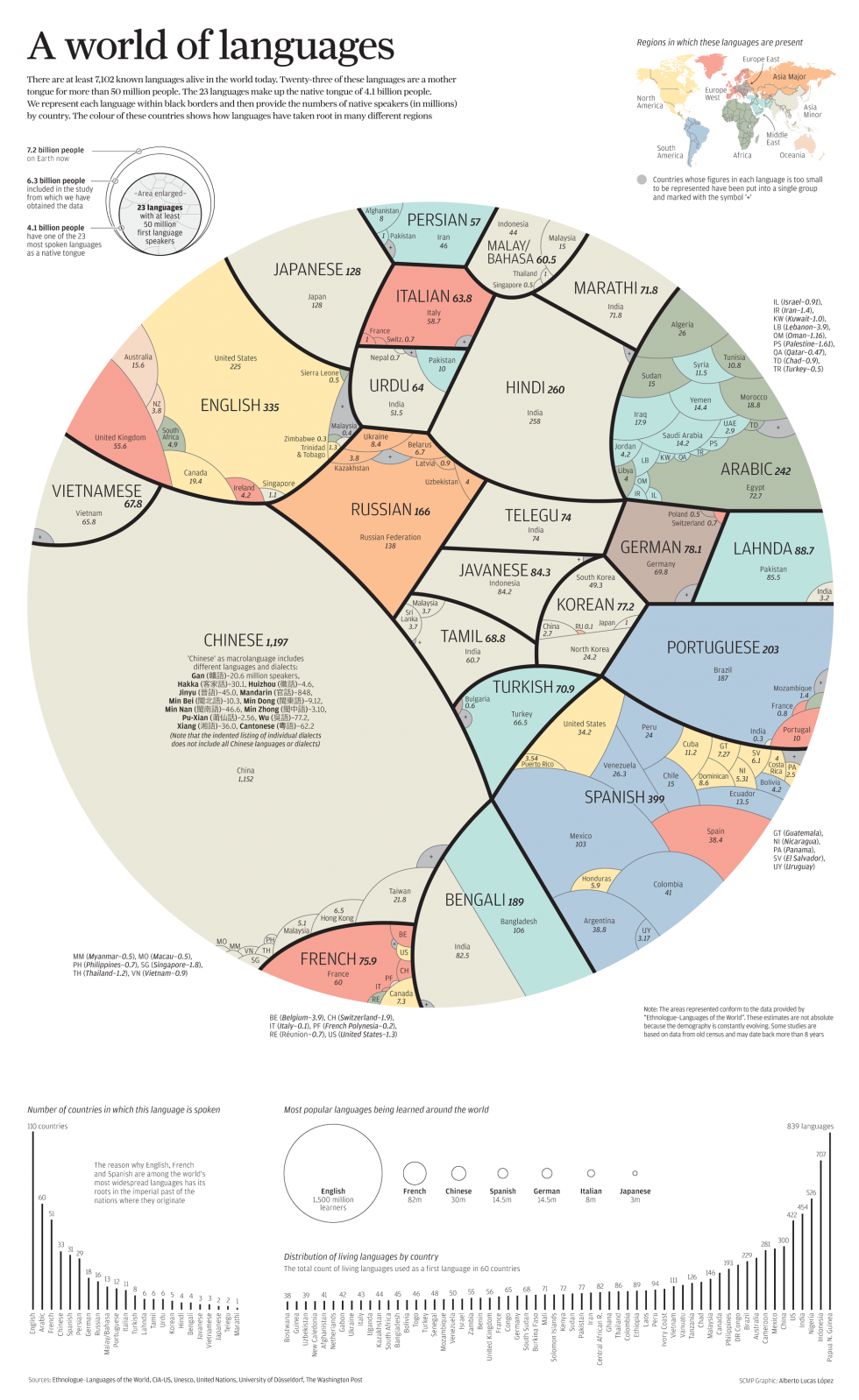
Cool!
Languages by number of speakers worldwide.
I do wonder how closely related the Chinese dialects are to each other, and if, for example, we could lump Spanish, Portuguese, French and Italian together the same way . .
Sunday, June 28, 2015
Cable Salad
Okay, so it's Cracked.com. Language warning. But I love reading about cliches, proverbs and vocabulary from other languages . . . just skip the first and last.
31 phrases English needs to steal
31 phrases English needs to steal
Saturday, June 27, 2015
musings prompted by bearing
Here, Bearing makes connections between Pope Benedict's encyclical and a Japanese book on decluttering. It's much less far fetched than you might think. But I was particularly struck by these two paragraphs.
This in turn doubles back to much of what Ann Voskamp has written on gratitude.
Given my fractious feelings with regards to patriotism and the American flag the last number of years, I like the handle that this gives.
I also think that it's interesting that *what* we respect is an indicator of what we are *grateful* for . . . somehow this all doubles back and relates to idolatry and desire . . . we are grateful for that which we deem to hold worth. What we *worship* . . .
Is the divide between the right and the left in large part a choice of different idols? That what we value as worthy of opposed?
Bearing's original post
Some of what St. Francis was getting at, when he preached to birds and addressed "brother sun, sister moon," is gratitude. Because that is what a Catholic vision of "respect for the natural world" must, in the end, be reduced to. Respect is actually something owed to persons, and all "respect" for objects, natural or man-made, is really a respect for persons; the object is merely a means of transmission. Example: we show respect for, say, an American flag, not for its own sake, but because it's a way to visibly respect people who also share that flag, sometimes (as at a military funeral) very specific people.
And we "respect" the natural world, not for its own sake, but (practically speaking) to steward it and share it for the sake of other people's livelihood, and (more fundamentally speaking) out of gratitude to God for making a gift of it to all of us. Wastefulness and an attitude of total control risk us taking for granted this world of objects for which we should give thanks every day.
This in turn doubles back to much of what Ann Voskamp has written on gratitude.
Given my fractious feelings with regards to patriotism and the American flag the last number of years, I like the handle that this gives.
I also think that it's interesting that *what* we respect is an indicator of what we are *grateful* for . . . somehow this all doubles back and relates to idolatry and desire . . . we are grateful for that which we deem to hold worth. What we *worship* . . .
Is the divide between the right and the left in large part a choice of different idols? That what we value as worthy of opposed?
Bearing's original post
Wednesday, June 24, 2015
Euchre
Or, as I thought of it when I was seven . . . Uker.
I love getting a probable etymology of both "Euchre" and "Bower."
http://www.theawl.com/2015/06/the-peoples-card-game
I love getting a probable etymology of both "Euchre" and "Bower."
http://www.theawl.com/2015/06/the-peoples-card-game

Tuesday, June 23, 2015
New Yorker article on euthanasia
A disturbing, fascinating look at the euthanasian movement in Belgium and Flanders. Andy's comment: " I was struck by the nihilism on display - death as the solution to problems, ranging from terminal illness to depression to mere unhappiness. People often complain that human suffering somehow implicates God in evil. I would reply that without God, suffering is meaningless and hopeless." Cross this with increasingly socialized health care and the inevitability of bureacrats deciding who it financially viable to treat or not and you have a horrible soup. And dad's assertion that delaying death is not actually the same thing as prolonging life . . . when our medical technology has advanced to the point when we can extend existence and suffering a very long time without actually curing anything, what is the righteous way forward? I don't know . . .
http://www.newyorker.com/magazine/2015/06/22/the-death-treatment
HT: Andy Scott, via FB
http://www.newyorker.com/magazine/2015/06/22/the-death-treatment
HT: Andy Scott, via FB
Thursday, March 20, 2014

Tuesday, July 23, 2013
Some random thougts on teacher evaluations and effectiveness
In response to this article on our new state superintendent.
One of the complaints is that under the old system, some 99% of teachers are labeled as effective. How can that be?! the cynics question. There have to be more ineffective ones! And on with the witch hunt and the standardized testing to find the supposedly ineffective teachers.
I'll believe 99% effectiveness and I'll tell you why--
1. Our colleges actually do a good job training teachers--as they're intended to.
2. People who are going into teaching are doing it because they want to see it done well--they're motivated because they *want* to be effective . . . for the kids. It's too hard of a job for someone who doesn't feel like they're managing or making a difference. The ineffective ones in many cases, wash themselves out.
3. Teaching jobs are hard enough to come by that our principals have lots of good choices when they're hiring. Our principals are good at what they do and hire the effective teachers in the first place.
4. They're aided in this by the fact that many (or most) teachers have been screened pretty well by the time they're hired. Teachers often work as subs, Title 1 aides, etc., before being hired on for a classroom. The principals already know who these people are before they hire them.
5. "Effective" is actually a pretty low standard. To say it's "effective" is to say, in essence, "Eh--it works . . . well enough." Most teachers are actually better than that. But the "good enough" standard is not actually that hard to reach for people who have been well taught, who are experienced, who are teaching because they want to, and have been hand-picked from a large pool. In fact--most teachers are better than that.
My mom is a teacher. I have friends who are teachers. And we have three kids in school. And not only have none of my kids ever had a teacher I would label as ineffective--none of the parents I know have either. (Check that--we did have a bad preschool experience once, but even Obama isn't trying to regulate the preschools yet). Mostly, our teacher experiences have been phenomenal. We had one time when we just didn't have a good personality fit between our daughter and her teacher--but that didn't mean the teacher was bad. She wasn't. There was also one time when a teacher was just having a really rough year. But again, didn't mean she was a bad teacher.
So let's back off on the regulations and the witch hunts. Let's let the school districts do their already hard enough job without federal mandates are committee created evaluations. Let's unschackle our creative, effective, motivated, hand-picked teachers to just do the one thing that they really want to do--help our kids. Because they truly are the 99%.
One of the complaints is that under the old system, some 99% of teachers are labeled as effective. How can that be?! the cynics question. There have to be more ineffective ones! And on with the witch hunt and the standardized testing to find the supposedly ineffective teachers.
I'll believe 99% effectiveness and I'll tell you why--
1. Our colleges actually do a good job training teachers--as they're intended to.
2. People who are going into teaching are doing it because they want to see it done well--they're motivated because they *want* to be effective . . . for the kids. It's too hard of a job for someone who doesn't feel like they're managing or making a difference. The ineffective ones in many cases, wash themselves out.
3. Teaching jobs are hard enough to come by that our principals have lots of good choices when they're hiring. Our principals are good at what they do and hire the effective teachers in the first place.
4. They're aided in this by the fact that many (or most) teachers have been screened pretty well by the time they're hired. Teachers often work as subs, Title 1 aides, etc., before being hired on for a classroom. The principals already know who these people are before they hire them.
5. "Effective" is actually a pretty low standard. To say it's "effective" is to say, in essence, "Eh--it works . . . well enough." Most teachers are actually better than that. But the "good enough" standard is not actually that hard to reach for people who have been well taught, who are experienced, who are teaching because they want to, and have been hand-picked from a large pool. In fact--most teachers are better than that.
My mom is a teacher. I have friends who are teachers. And we have three kids in school. And not only have none of my kids ever had a teacher I would label as ineffective--none of the parents I know have either. (Check that--we did have a bad preschool experience once, but even Obama isn't trying to regulate the preschools yet). Mostly, our teacher experiences have been phenomenal. We had one time when we just didn't have a good personality fit between our daughter and her teacher--but that didn't mean the teacher was bad. She wasn't. There was also one time when a teacher was just having a really rough year. But again, didn't mean she was a bad teacher.
So let's back off on the regulations and the witch hunts. Let's let the school districts do their already hard enough job without federal mandates are committee created evaluations. Let's unschackle our creative, effective, motivated, hand-picked teachers to just do the one thing that they really want to do--help our kids. Because they truly are the 99%.
Friday, June 7, 2013
Book Review: Goodness and Mercy by Patti Hill
It's 1943 and sixteen year old Lucy Richter is desperate to keep what is left of her family together. Her eight year old twin siblings Goody and Mercy were taken to the orphanage after their parents left and now Goody is going to be adopted out. She kidnaps the twins and flees to the dubious shelter of an aunt she's never met.
That's the slow start to a story that really picks up when the siblings get to their aunt in Colorado. Patti Hill is a deft writer who handles a multi-first person viewpoint story with skill. Letters from Aunt Ava from 1994, letters from a soldier in the Pacific, and 1943 scenes from Lucy and Mercy. She tackles issues of doubt and faith, love, family . . . and God's goodness and mercy. His hesed, in the Hebrew. It's the word that gets translated loving-kindness, mercy, faithfulness and covenant faithfulness in English. It's all of these and more--a concept that English just doesn't have a big enough word for. It's that God's plans and healing are bigger than we can imagine, that our small unfaithfulness-es are as loose bracken to be washed away in the river of his love and forgivenss.
Too much Christian fiction is far too small. Too-small people with too-small problems (and too-big angst over them) that they manage to bring to a too-small God, who can make things shiny and happy. Patti Hill gives us a world where good and evil are tangled together in a complicated mess. Good intentions, selfish intentions, faith and doubt, guilt and righteousness speckled through the same characters. She gives us real people--all of them with their own pain. And she gives us a God big enough--and personal enough--to see and hold and speak to each and every one of them. Four stars.
That's the slow start to a story that really picks up when the siblings get to their aunt in Colorado. Patti Hill is a deft writer who handles a multi-first person viewpoint story with skill. Letters from Aunt Ava from 1994, letters from a soldier in the Pacific, and 1943 scenes from Lucy and Mercy. She tackles issues of doubt and faith, love, family . . . and God's goodness and mercy. His hesed, in the Hebrew. It's the word that gets translated loving-kindness, mercy, faithfulness and covenant faithfulness in English. It's all of these and more--a concept that English just doesn't have a big enough word for. It's that God's plans and healing are bigger than we can imagine, that our small unfaithfulness-es are as loose bracken to be washed away in the river of his love and forgivenss.
Too much Christian fiction is far too small. Too-small people with too-small problems (and too-big angst over them) that they manage to bring to a too-small God, who can make things shiny and happy. Patti Hill gives us a world where good and evil are tangled together in a complicated mess. Good intentions, selfish intentions, faith and doubt, guilt and righteousness speckled through the same characters. She gives us real people--all of them with their own pain. And she gives us a God big enough--and personal enough--to see and hold and speak to each and every one of them. Four stars.
Friday, March 29, 2013
Linky Fest
It's been a long time since I blogged regularly--about since our fourth was born. He's two and a half now, and I would like to get back to it now that the most distracting stage of babydom is passing. I admire those women who can get all sorts of coherent thoughts out with little ones running around. I'm not one of them. But to get things rolling, here are some of the scads of tabs that I have up that I don't want to lose.
Poetry from John Donne, for Good Friday. And more of it.
A book on the Gypsies that looks very interesting.
Pixar's 22 rules of story telling
David Hartley Bent on the brilliantly bad Irish writer Amanda McKittrick Ros
A study of Ancient Roman hairstyles
An article on the rising number of diability cases
John Stackhouse talks about forgiveness in the Lord's Prayer
Richard Beck looks at the solar and lunar calenders and how date for Easter is determined
and finally, songs by Toby Mac and J Moss that I need to download for our daughter who is dancing to them for her spring dance recital.
There we are. A little bit of the fuel of the rock tumbler in my brain. Blessings on you all this Easter Weekend.
Poetry from John Donne, for Good Friday. And more of it.
A book on the Gypsies that looks very interesting.
Pixar's 22 rules of story telling
David Hartley Bent on the brilliantly bad Irish writer Amanda McKittrick Ros
A study of Ancient Roman hairstyles
An article on the rising number of diability cases
John Stackhouse talks about forgiveness in the Lord's Prayer
Richard Beck looks at the solar and lunar calenders and how date for Easter is determined
and finally, songs by Toby Mac and J Moss that I need to download for our daughter who is dancing to them for her spring dance recital.
There we are. A little bit of the fuel of the rock tumbler in my brain. Blessings on you all this Easter Weekend.
Monday, December 3, 2012
A few random thoughts on various children's books
In Maurice Sendak's "Where the Wild Things Are," when the forest starts to grow in Max's room, the moon appears to be a crescent. At least, there is only a crescent of it that is bright. At the end of the book, when he sails back into the night of his very own room, the moon is solidly full. Am I making too much of a bit of artistic variation? Maurice Sendak is too good of an artist for this to be accidental, I think.
"Chicka Chicka Boom Boom" just keeps getting better and better the more children I read it to. All four of my very different children have loved it in very different ways. Our first, fascinated by words and letters from the get-go, loved the letters and would spend as much time poring over the alphabets at the beginning and end as on the story itself. And she could recite the story itself (and did--"reading" it to Grandma over the phone) before she was three. Our second daughter loved any book with a strong rhythm. "Chicka Chicka Boom Boom" was tied with "Hand, Hand, Fingers, Thumb" for her favorite. Our third daughter, for reasons which never did become clear to me only wanted to talk about the "coke-na-nuts." Our fourth, our son, is proving himself all boy. One of his first words was "Boom!" and he will chime with the "Boom! Boom!" right on cue in the story when all the letters fall out of the tree.
Speaking of "Hand, Hand, Fingers, Thumb," what's with all those monkeys? My mom says that the book reads like someone's LSD trip out of the 60's. I don't think I disagree.
The late Jack Kent had a wonderfully subversvive sense of what is real and what is not. "Mr. Meebles" (1970) features the boy Donald's imaginary friend who comes to life when he claims the note that Donald writes about him. I think that it's actually a story about story-telling, and closes with one of the most brilliantly surreal, post-modern pieces of dialogue that you're likely to find in a picture book:
"Mr. Meebles" is out of print, but "There's No Such Thing As a Dragon" (1975) is readily available. The theme here is distinctly less abstruse. A dragon shows up in Billy's bedroom one morning, but Billy's mother tells him that dragons don't exist. It has to run off with their house on his back before Billy's mother is willing to admit to the existence of evidence which challenges her preconceived conclusions. I'm grateful to my mother-in-law for saving these from my husband's childhood stash.
The province of British Columbia gave "One Gray Mouse" out to every newborn born there in the year 2000, so we received it with our eldest daughter. It's one of the best color and counting books I've seen, and there are a lot of both of those.
I'm enjoying Simcha Fisher's Advent book recommendation blog series. I may never read "Goodnight Moon" the same way again though. It had never occurred to me before to be bothered by the fact that there's a bowl of mush left out all night at room temperature--but I doubt now that I'll ever be able to forget it.
What's struck you as an adult, reading or re-reading children's picture books?
"Chicka Chicka Boom Boom" just keeps getting better and better the more children I read it to. All four of my very different children have loved it in very different ways. Our first, fascinated by words and letters from the get-go, loved the letters and would spend as much time poring over the alphabets at the beginning and end as on the story itself. And she could recite the story itself (and did--"reading" it to Grandma over the phone) before she was three. Our second daughter loved any book with a strong rhythm. "Chicka Chicka Boom Boom" was tied with "Hand, Hand, Fingers, Thumb" for her favorite. Our third daughter, for reasons which never did become clear to me only wanted to talk about the "coke-na-nuts." Our fourth, our son, is proving himself all boy. One of his first words was "Boom!" and he will chime with the "Boom! Boom!" right on cue in the story when all the letters fall out of the tree.
Speaking of "Hand, Hand, Fingers, Thumb," what's with all those monkeys? My mom says that the book reads like someone's LSD trip out of the 60's. I don't think I disagree.
The late Jack Kent had a wonderfully subversvive sense of what is real and what is not. "Mr. Meebles" (1970) features the boy Donald's imaginary friend who comes to life when he claims the note that Donald writes about him. I think that it's actually a story about story-telling, and closes with one of the most brilliantly surreal, post-modern pieces of dialogue that you're likely to find in a picture book:
"How can you be here when I wasn't even thinking about you?" asked Donald. "You're just an idea, and--"And so our characters take on a life of their own.
"And an idea doesn't exist unless somebody has it. That's what you told me," said Mr. Meebles. He reached into his hat, pulled something out of it, and said, "Well . . . I HAVE it. You wrote it down on this piece of paper yesterday and went out without it."
And so it was that Mr. Meebles no longer had to depend upon Donald. Mr. Meebles was still only an idea. But the idea was his own now. Donald told him he could keep it.
"Mr. Meebles" is out of print, but "There's No Such Thing As a Dragon" (1975) is readily available. The theme here is distinctly less abstruse. A dragon shows up in Billy's bedroom one morning, but Billy's mother tells him that dragons don't exist. It has to run off with their house on his back before Billy's mother is willing to admit to the existence of evidence which challenges her preconceived conclusions. I'm grateful to my mother-in-law for saving these from my husband's childhood stash.
The province of British Columbia gave "One Gray Mouse" out to every newborn born there in the year 2000, so we received it with our eldest daughter. It's one of the best color and counting books I've seen, and there are a lot of both of those.
I'm enjoying Simcha Fisher's Advent book recommendation blog series. I may never read "Goodnight Moon" the same way again though. It had never occurred to me before to be bothered by the fact that there's a bowl of mush left out all night at room temperature--but I doubt now that I'll ever be able to forget it.
What's struck you as an adult, reading or re-reading children's picture books?
Tuesday, November 27, 2012
The Anchoress, over at First Things today, quotes theologian Timothy Muldoon:
“The Lord of the visible and invisible is calling to us through the voice of our most authentic selves with the words “discover your real self. Then give it away.”
I find this very interesting. It undermines, beautifully, the broken, self-immolating, idea of service that so many Christians (especially women) are subjected to.
First. It is only logical that we can only truly give ourselves away if it is truly ourselves that we give. If we give something other than what we truly are, we give falsely, and indeed, we give what is not our own to give. We can only righteously and rightfully give that which God has given to us.
Second. The process of self discovery is not merely for self-gratification, or for the ever-ellusive self fulfillment. It is to discover what it is that we have to give.
Third. God made us in order for us to be give ourselves away. It is only in the giving that the purpose of our being finds completion. Merely discovering ourselves cannot bring fulfillment. That would be like laying the meal out on the table and then standing there and smelling it, but refusing to eat. Only the meal consumed has, as we cheekily tell the kids, fulfilled its destiny.
(Hey there--aren't you going to eat your dinner? You're making your food feel bad, sitting there on your plate. It wants to be eaten. Being eaten is its purpose in life. Listen--can't you hear your broccoli saying, "Eat me! Eat me! I taste good!)
“The Lord of the visible and invisible is calling to us through the voice of our most authentic selves with the words “discover your real self. Then give it away.”
I find this very interesting. It undermines, beautifully, the broken, self-immolating, idea of service that so many Christians (especially women) are subjected to.
First. It is only logical that we can only truly give ourselves away if it is truly ourselves that we give. If we give something other than what we truly are, we give falsely, and indeed, we give what is not our own to give. We can only righteously and rightfully give that which God has given to us.
Second. The process of self discovery is not merely for self-gratification, or for the ever-ellusive self fulfillment. It is to discover what it is that we have to give.
Third. God made us in order for us to be give ourselves away. It is only in the giving that the purpose of our being finds completion. Merely discovering ourselves cannot bring fulfillment. That would be like laying the meal out on the table and then standing there and smelling it, but refusing to eat. Only the meal consumed has, as we cheekily tell the kids, fulfilled its destiny.
(Hey there--aren't you going to eat your dinner? You're making your food feel bad, sitting there on your plate. It wants to be eaten. Being eaten is its purpose in life. Listen--can't you hear your broccoli saying, "Eat me! Eat me! I taste good!)
Wednesday, October 3, 2012

Tuesday, October 2, 2012
Song of Moses
What's even better than tracking down a decent recording of that 1970's praise song that's been running through your head since you were about eight years old? Finding one recorded by 1980's era Petra. Nostalgia score!
Wednesday, May 30, 2012
Book Review: Sabbath, by Dan Allender

Allender has a clean, conversational and intimate writing style. In some ways, this book is an easy read. But in many ways this is one of the more difficult books I have read. The matieral that he lays out is dense and demands much consideration. I found that I could no more read this book quickly than I could eat an entire chocolate mousse cake in one sitting. Allender aims to be both grace-filled and convicting in this read. He points out that keeping the Sabbath is one of the ten commandments and views ignoring it is a sin right there together with murder and adultery. On the other hand, the vision that he paints for keeping Sabbath is so anti-legalistic that he leaves you wondering why anyone would not want to keep it.
I found this book peculiarly unsatisfying though because Allender is extrapolating in large part from personal experience and he starts from a massively different stage of life from the one in which I presently find myself. As a mother with four children, my life, my worship, and my work are entangled with each other. The children still need to be fed on Sunday. More, the children still need to be taught and trained on Sunday. In fact, training them in worship is one of the fundamental duties and responsibilities of a Christian parent. It's one I'm priviliged to have, but--make no mistake--it *is* work. In addition, as a pastor's wife, my husband's work week culminates with Sunday morning. Sunday is not his Sabbath. So then, if Sabbath is in part about community, how do we attend to it together as a family? Do I personally try to keep it separate from my children? Or how do I keep it together with them, when the work of parenting them is my work? Allender addresses none of these concerns. What he can do as a man with a day job, weekends off, and children grown is something different from what I find available to me. Recommended with caveats. Four stars.
I received this book from Thomas Nelson for review purposes as part of their BookSneeze program.
Thursday, December 22, 2011
Guest Blogging: Advent Love: Day 5
Given that this is Love week, let's talk about the love of God for a few minutes. God loves you. I expect that if you're reading this, you know that. And God loved us all Soo--ooo much that he sent Jesus down as a baby to be born . . . upon a midnight clear . . . and laid in the sweet smelling hay . . . with the gentle beasts all around him . . . and we cast the scene in a sentimental soft light glow, and call that the love of God during this season. But you know what? The love of God is bigger and brighter than that. More difficult. More all-consuming. Less a 40 watt light bulb, and more of a nuclear explosion.
There's a great Old Testament word--hesed. (It's one of my pastor-husband's favorite words to preach on.) It gets translated love, loving-kindness, mercy, faithfulness, covenant faithfulness. It's all those things and more. The Jesus Storybook Bible talks of it as God's "Never Stopping, Never Giving Up, Unbreaking, Always and Forever Love." It's God keeping his promises to us, and finding a way to rescue us from our sin because it's who he IS, and he can no more be unfaithful or unloving to us than we can make a square circle or smell blue. It would be a nonsensical impossibility.
And this is the love of God that is being called on and celebrated in the readings this morning. Psalms 146 and 147, two of the great praise psalms, remind us that hope and salvation are in God. That he is our faithful king, that he rescues all who call him . . . and that if we look to people for the sort of salvation and faithfulness that only come from God, we're going to be disappointed every time. But Yahweh lifts up the humble and heals the broken-hearted. It is with the knowledge and assurance of the hesed of God that the psalmist of Psalm 80 calls for rescue. And then we get to Zechariah, and I'm going to steal a little from tomorrow's reading, because the canticle of Zechariah is one of the great songs of the Bible.
“Blessed be the Lord God of Israel,
for he has visited and redeemed his people
and has raised up a horn of salvation for us
in the house of his servant David,
as he spoke by the mouth of his holy prophets from of old,
that we should be saved from our enemies
and from the hand of all who hate us;
to show the mercy promised to our fathers
and to remember his holy covenant,
(Luke 1:68-72 ESV)
That showing mercy? That's hesed, there. But let's look just a second at just who God redeems and how and why. He redeems his people. He raised up a horn of salvation for us. He calls us and redeems us together. Now of course, there is no group that is not made up of individuals, but God doesn't leave us alone to be individuals. He puts us together with other people to . . . do hesed to each other. To love each other. Be faithful to each other. To help each other along the path of redemption.
Real love is hard. Loving real people with real problems is hard. That's one of the reasons that the soft-glow version of Christmas doesn't really do us much good. If we have a God who nicely loves people who don't actually have much in the way of problems that they need fixed, it doesn't help us in loving each other when we run facelong into the fact that really loving real people, in our church, in our marriages, with our children, in our communities, is rather horribly gritty most days. Loving my kindergartner when she's home sick with stomach flu . . . well, there's just not much you can do to romanticize that, or cast it in a 40 watt glow. But God, in his Never Stopping, Never Giving Up Love, becomes Incarnate. He detonates a bomb of mercy, grace, forgiveness and God-With-Us-ness into our world, because that's what it needs, and so that's what he's going to give.
God loves you. God loves me too. He loves my kids, more than I do. He loves the elderly lady in the pew across the aisle, and the uncooperative kid who just wants to lie on the floor during junior church. He meets us at the point of our brokenness and dwells with us and loves us, and heals us, and saves us. And by loving us this way, God teaches us how to love this way. He shows us that love starts with being present. Which he is. That is reason for praise.
The LORD will reign forever,
your God, O Zion, to all generations.
Praise the LORD!
(Psalm 146:10 ESV)
Subscribe to:
Posts (Atom)